
Germantown, Maryland. Serving Maryland, Washington DC, Virginia and Pennsylvania, and traveling nationwide. 443-987-3502 estimating@pfrcontractingllc.com Report a leak

The job is planned before the first man goes up

Every PFR crew receives a written operations handbook, a materials loading and safety plan drawn on the roof, and a video briefing in Spanish and in English before the job starts. The pages and clips below are taken from real 2026 jobs. Customer, site and supplier names have been removed.

What the crew holds on day one

The preconstruction package

A commercial roof is lost or won in the first week: where the trucks park, where the crane lands, which strip opens first and how it closes by the end of the day. We settle those questions on paper before mobilization, and we settle them in the language of the people doing the work.

Customers receive the same package, so the superintendent, the consultant and the foreman are reading from one document.

  • Crew operations handbook. The building, the hours, the site rules, the sequence by area and strip, the hold points, the daily routine and the safety rules that do not change.
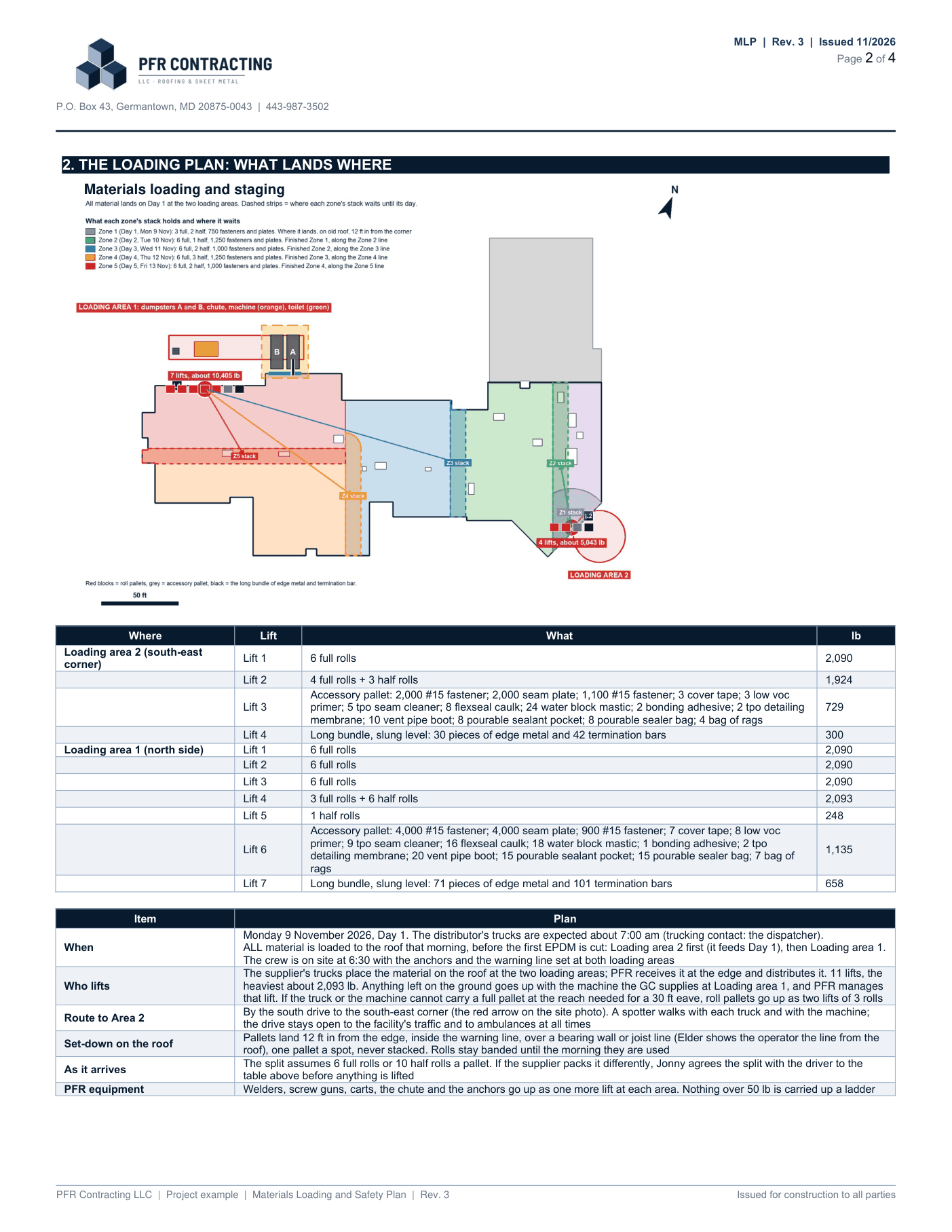
  • Materials loading and safety plan. Every lift with its weight and where it lands, drawn on the roof plan, with the staging move for each zone and the controls for working at the edge.
  • Foreman's sheet. One page with the roof plan colour-coded by day, so the sequence can be read without reading.
  • Video briefing. The handbook spoken over slides, in Spanish for the crew and in English for the customer, watched by every man before the first shift.
  • Daily report. Men, quantities by operation, weather, hold points passed, photographs and tomorrow's plan, in English, the same day.

From the handbooks

Pages the crew works from

Three pages from a materials loading and safety plan for a mechanically attached TPO re-roof, and two from a crew operations handbook for a large new data hall. Click a page to open it full size.

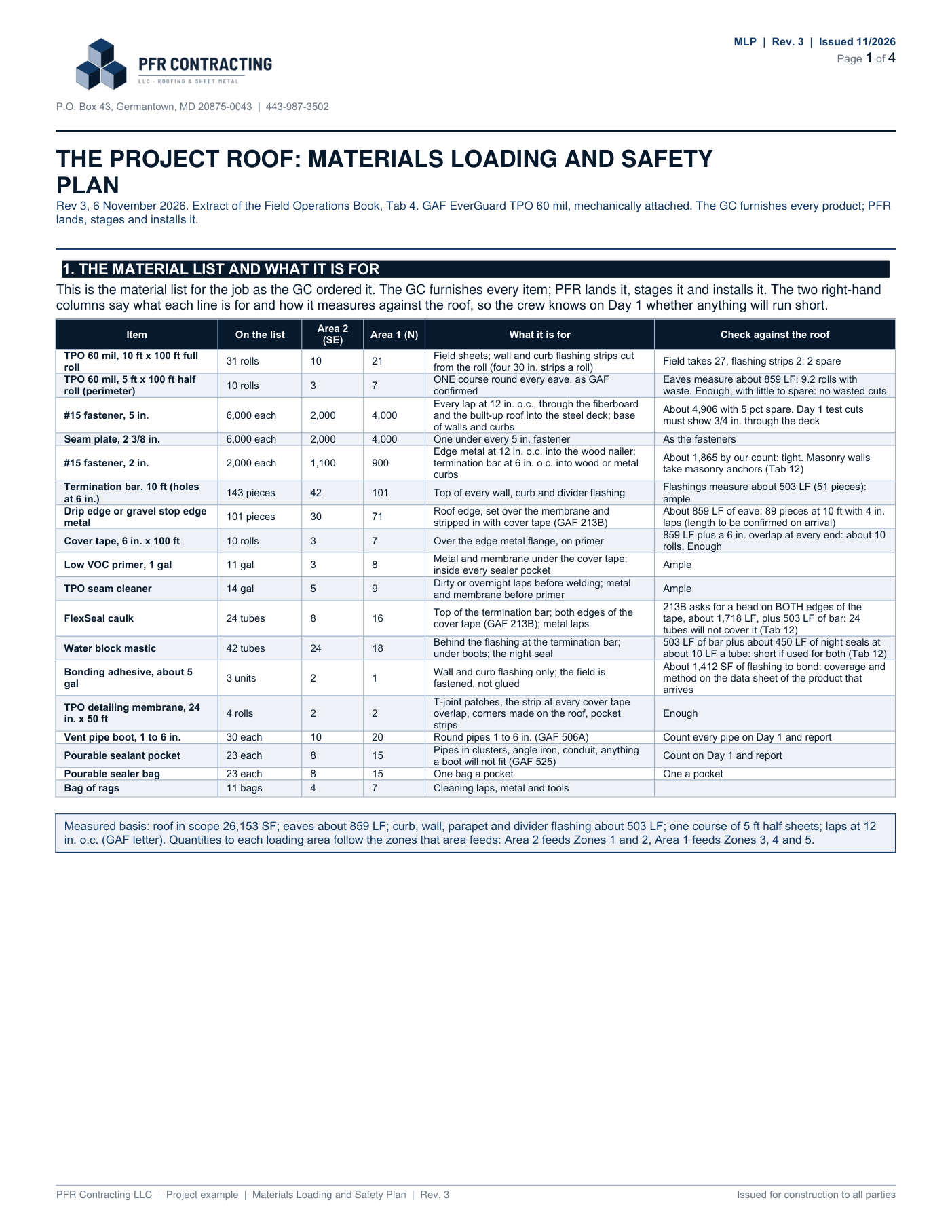
Materials Loading and Safety Plan, page 1
Materials Loading and Safety Plan, page 1. The material list as the customer ordered it, with two columns the crew reads on day one: what each line is for, and how it measures against the roof, so a shortfall is found before the first cut.
Materials Loading and Safety Plan, page 2
Materials Loading and Safety Plan, page 2. The loading plan drawn on the roof: two loading areas, each zone's stack and where it waits, lift by lift with weights, and the plan for the morning the trucks arrive.
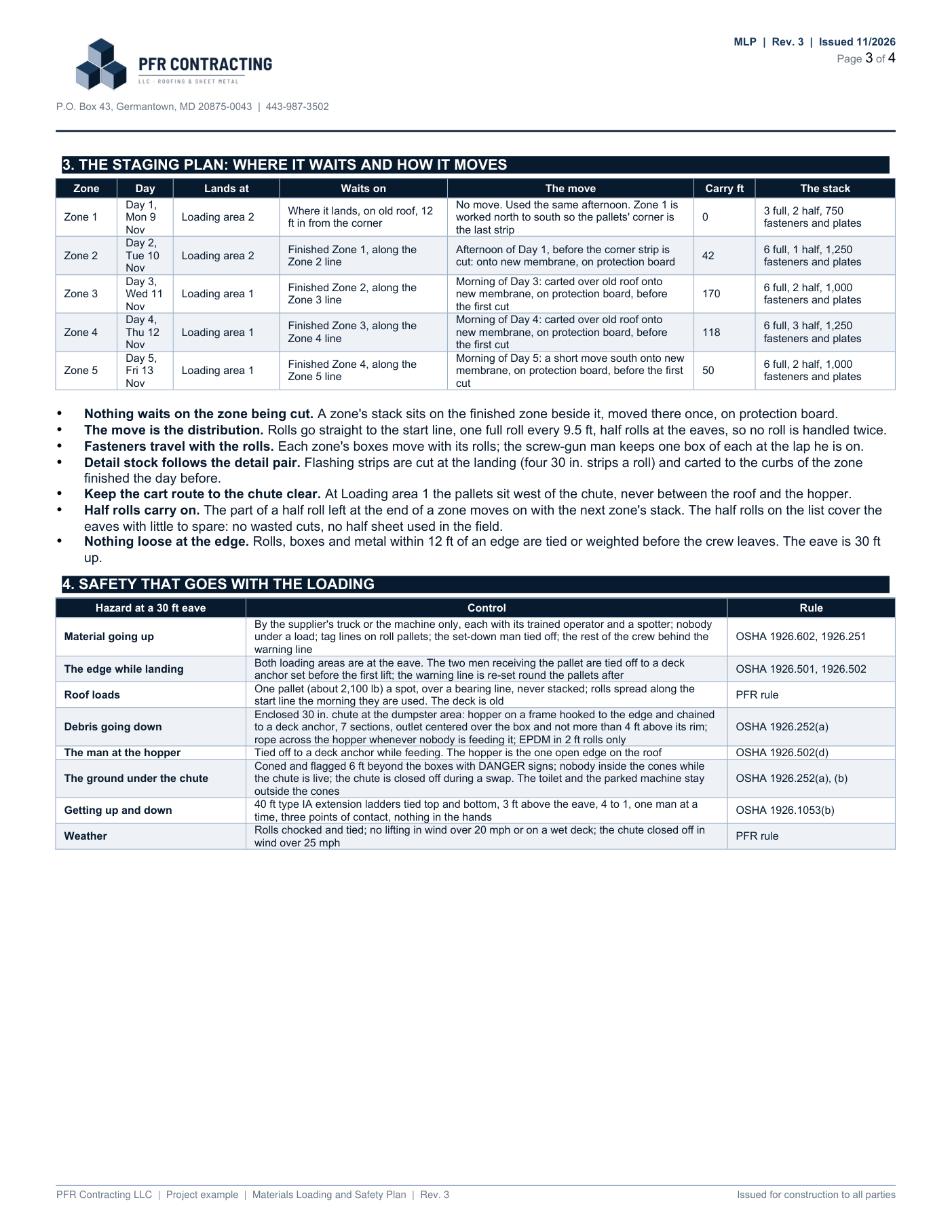
Materials Loading and Safety Plan, page 3
Materials Loading and Safety Plan, page 3. The staging plan, zone by zone, with the carry distance for every move, and the safety that goes with loading at a 30 ft eave, each control against its OSHA rule.
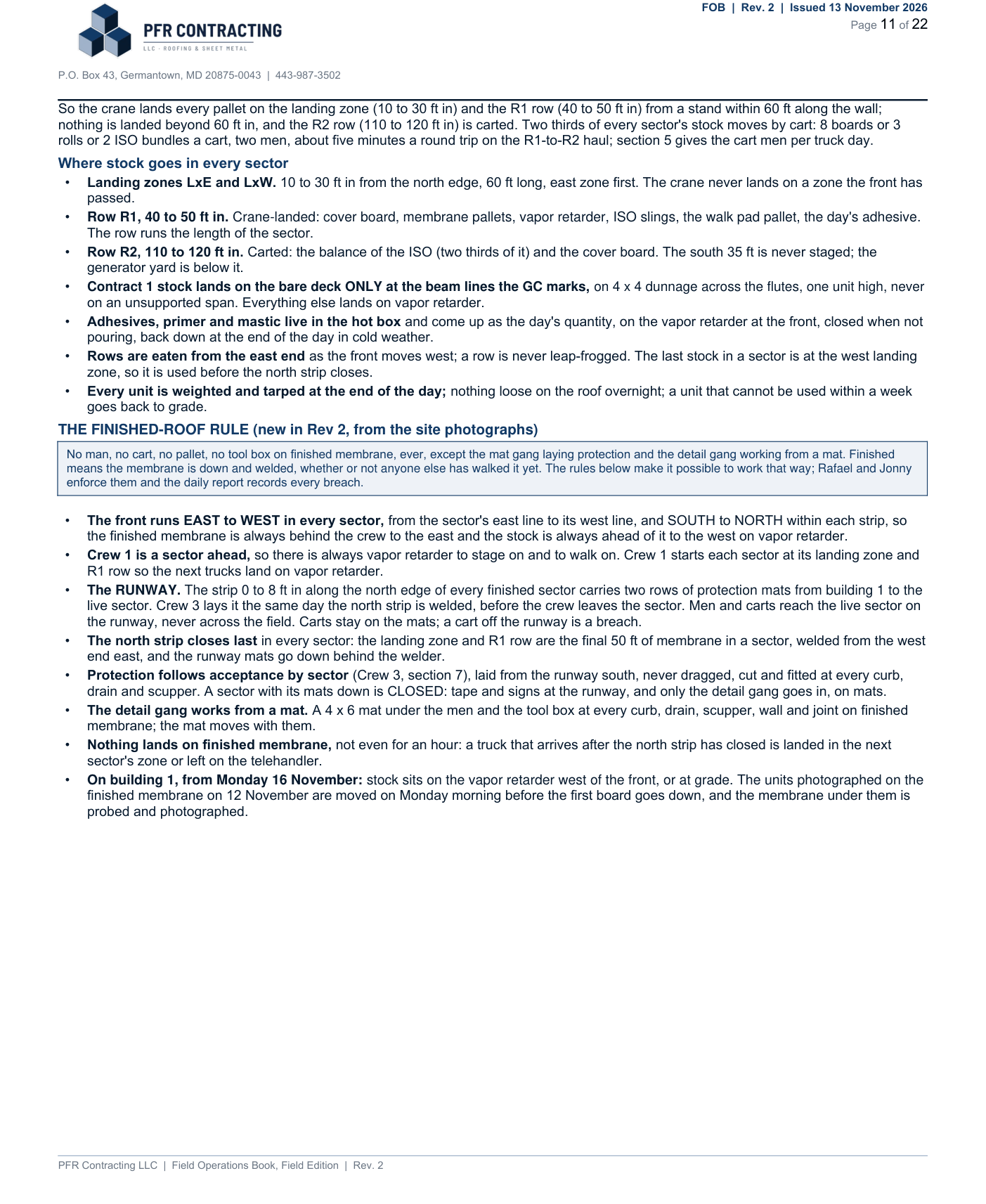
Crew Operations Handbook, staging and the finished-roof rule
Crew Operations Handbook, staging and the finished-roof rule. Where stock goes in every sector on a large new deck, how far the crane reaches and where the carts take over, and the rule that nothing is landed, staged or walked on finished membrane.
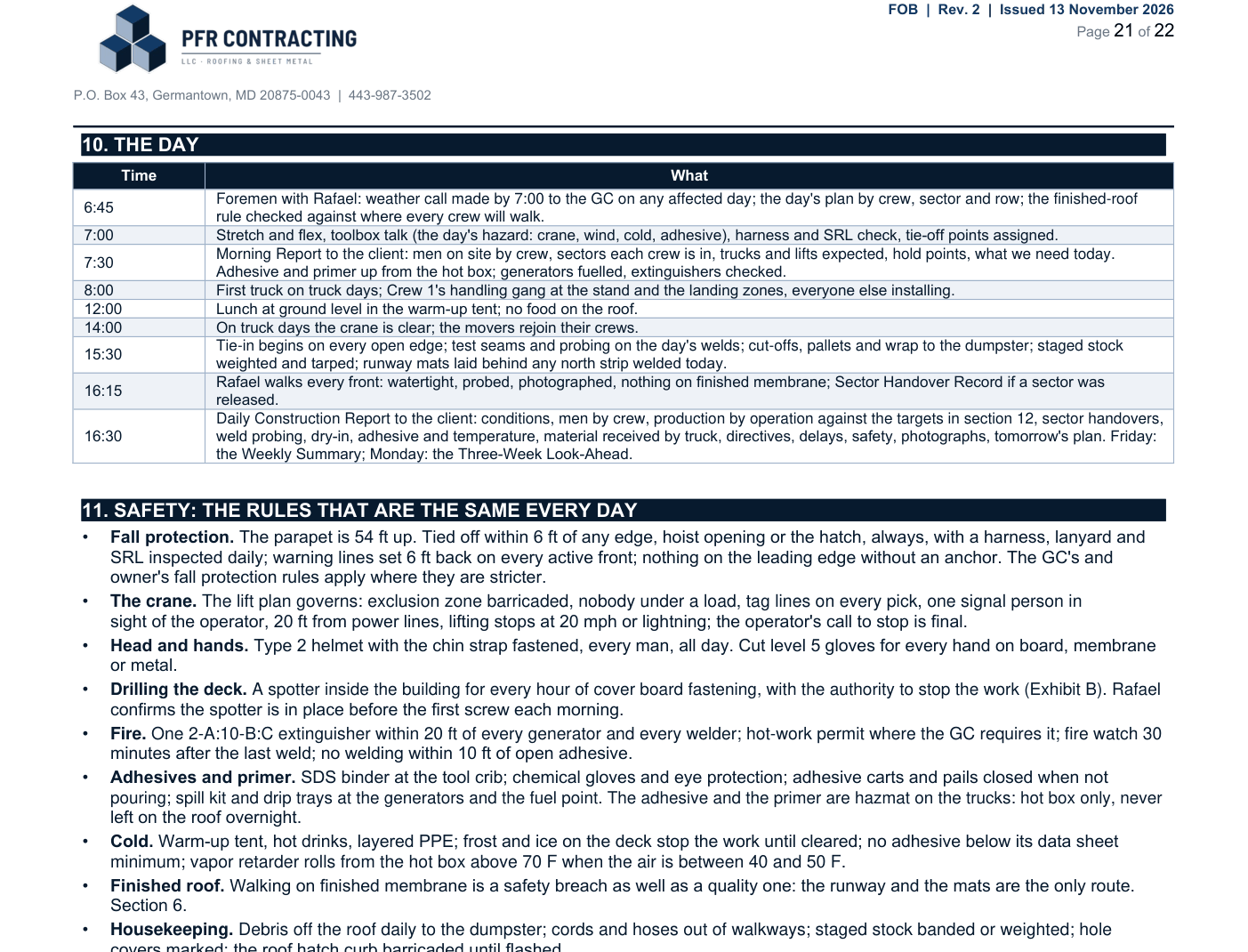
Crew Operations Handbook, the day and the safety rules
Crew Operations Handbook, the day and the safety rules. The day from the 6:45 weather call to the 16:30 daily report, and the safety rules that are the same every day: fall protection, the crane, the deck, fire, adhesives, cold and housekeeping.

From the video briefing

Five excerpts, in English

The crew watches the full briefing in Spanish. These are the English versions of five parts, taken from two jobs: a ballasted recover on an occupied office building, and a new roof on a data hall under construction. Captions and a transcript are provided with each clip.

Excerpt 1 of 5

Rule number one, and the building rules

From a ballasted recover on an occupied office building. The crew hears the one rule the whole job runs on, the hours, and what we do and do not do in a building full of people.

Read the transcript

This is the crew video briefing. Before a job starts, every crew watches it, in Spanish and in English, so nobody has to read the handbook to know the job. This excerpt is from a ballasted recover on an occupied office building: rule number one, the hours, and the building rules.

It is a four-story office building, L-shaped, and it is occupied. There are people working inside all day. The roof is about fifty-three thousand square feet: five hundred thirty squares. It is a ballasted recover. The old insulation and the old membrane stay. On top goes new board, loose-laid. On top of that, new membrane, loose-laid, with tape at the laps. Then filter fabric. And on top, the same river stone, screened on the roof and put back. Nothing is adhered in the field. Only the flashings are adhered.

This is rule number one for the whole job, and you will hear it in every video. Open only what closes today. A strip opened in the morning is closed, sealed and under stone before four-thirty in the afternoon. If it cannot be closed today, it is not opened.

The hours are six in the morning to five in the afternoon. Noisy work, the screener and the grinder, only before eight in the morning. After eight, no loud noise. There are offices below us.

In and out only through the loading dock. Never through the main entrance. Never leave a door propped open: the alarm goes off and there is a fine. Every morning the floor protection goes down on the dock route. Nobody goes down into the building without an escort. Nothing is left in the corridors. Parking is where the building says, never at the dock.

Some things are not ours and are not done. We do not move antennas without the building's superintendent. We do not disconnect anything electrical or mechanical. We do not do extra work because someone asked for it verbally. If someone from the building asks you for something, the answer is: talk to my foreman. The foreman calls the office.

Excerpt 2 of 5

The nine passes, strip by strip

The same job, inside each strip. Nine passes, always in the same order, so a strip opened in the morning is under stone before the end of the day.

Read the transcript

The nine passes. Inside each area, the work goes by strips. A strip is what the crew can open and close in one day: about two thousand five hundred square feet. In every strip there are nine passes, always in the same order.

Pass one. Lift pavers and mats. Before a single paver moves, take a photograph of how they are laid out. At the end they go back the same way. Stack them on the roof, in their own strip, never between the joists.

Pass two. The stone from the strip ahead goes through the screener. The fines, the broken concrete and the metal go out in bags. The clean stone stays on the roof and goes onto the finished strip behind. The stone never leaves the roof. It is never heaped. The screener sits on a support line, where the plan says.

Pass three. Strip the old flashings and the old metal. If you see an open joint in the concrete or a damaged reglet, report it before it gets covered.

Pass four. Vent holes in the old membrane. One three-quarter-inch hole every ten by ten feet. Only in the strip being covered today. Never ahead.

Pass five. The fanfold board. Tight, joints staggered, and weighted down the moment it is laid. It is never left without weight. The wind takes it.

Pass six. The membrane. Let it relax. Side laps go on the six-inch factory tape. End laps are taped. Primer, dry to the touch, roller, and probed. When the consultant asks, two seam samples a day, patched the same day.

Pass seven. Base flashings, drains, scuppers and penetrations. Within the same strip, before the stone goes back on that edge. Drains with their clamping ring and their strainer.

Pass eight. Filter fabric and the clean stone back on. Twelve-inch laps in the fabric. Stone even, thirteen to fifteen pounds per square foot. No fabric showing. No heaps. The strip is closed and sealed before four-thirty.

Pass nine. Stainless counterflashing in the reglet, lead wedges at twelve inches, sealant tooled. And the pavers back, as the photograph says.

Nine passes, always in this order, strip by strip. If a strip is not going to close today, the screener stops and everyone moves to closing.

Excerpt 3 of 5

Quality: what is checked before covering

What is checked before every layer is covered, from the date printed on each membrane roll to the probe on every lap, and what to do when the board is wet.

Read the transcript

Quality. This roof carries a twenty-year manufacturer warranty. The consultant and the owner's engineer can come up to inspect at any time. Everything we cover has to be right before it is covered, because afterwards it cannot be seen.

Every membrane roll that arrives is checked. Find the printed date. Photograph it. If the roll has no date, or is more than four months old, it is rejected. It is not installed. Tell the foreman.

The laps. Every lap is primed, left to dry to the touch, closed onto the tape, rolled, and probed. A lap that was not rolled is a lap that opens. Two two-inch samples a day when the consultant asks for them, patched before the end of the day.

The base flashings are fully adhered with the adhesive, a reinforced strip at every termination, fasteners at twelve inches, and sealant on every edge before the end of the day. The adhesive is stored above sixty degrees Fahrenheit. Cold, it does not stick.

The hold points. Before every layer: stop, check, photograph, then cover. Strip opened: pavers photographed, old membrane swept, wet board reported? Board: tight and weighted? Membrane: laps rolled and probed? Flashings: reinforced strip and fasteners? Stone: even, no fabric showing? Strip closed: sealed before four-thirty?

If you find board that is wet or soft underfoot, or the deck sounds hollow: do not cover it. Photograph it. Tell the foreman. He fills in the form and calls the office. What is covered wet rots under the warranty, and then it is ours.

Nothing improvised. Every detail as the manufacturer's drawing says. If you do not know how it goes, ask before, not after.

Excerpt 4 of 5

Crane days and the finished-roof rule

From a data hall under construction. Where the crane lands material, how a truck day runs, what must be true before the first pick, and the finished-roof rule.

Read the transcript

Crane days and the finished-roof rule. This excerpt is from a data hall under construction: where the crane lands material, how a truck day runs, what must be true before the first pick, and the rule that nothing is landed, staged or walked on finished membrane.

The sixty-foot rule. The crane lands on the landing zone, ten to thirty feet in, and on row R one, forty to fifty feet in, always from a stand within sixty feet along the wall. Nothing is landed beyond sixty feet in. Row R two, one hundred ten to one hundred twenty feet in, is filled by cart: two thirds of the insulation and the cover board. A cart carries eight boards, or three rolls, or two insulation bundles, with two men, and takes about five minutes a round trip. Two thirds of every sector's stock moves by cart. The cart men are part of the plan, not an extra.

The truck day, in order. The first truck arrives at eight, then one an hour; the last pick is off the hook by two. A truck that arrives after one is unloaded to the laydown by the telehandler and landed the next morning. Landing never waits for a cart: units land in the zone, and the cart men clear them to rows R one and R two between picks. A unit that cannot be cleared is landed in the next zone, never on membrane. The foreman confirms the next phase ten working days ahead, and reports the same day any truck that differs from its bill of lading.

Before the first pick all of this must be true. The operator on mats, outriggers out, with the lift plan for that stand in hand. Exclusion zone barricaded; nobody under a load, ever; tag lines on every pick. One signal person in sight of the operator; the riggers on the ground with their certifications already submitted. The landing zone coned, on the joist lines the general contractor marked. Wind under twenty miles an hour, no lightning, and twenty feet from any power line. The load within the chart for that radius. And the operator's call to stop is final.

The finished-roof rule. No man, no cart, no pallet, no tool box on finished membrane. Ever. Finished means the membrane is down and welded, whether or not anyone has walked it yet. The only exceptions are the mat gang laying protection, and the detail gang working from a mat. The superintendent enforces it, and every breach goes on the daily report.

At the end of every day. A watertight temporary tie-in on every open edge, with no board or insulation exposed; inspected before leaving the roof, and removed before continuing the next day. Cut-offs, pallets and wrap to the dumpster; cords and hoses out of the walkways. Staged stock weighted and tarped; adhesive and primer back to the hot box. Runway mats laid behind any strip welded today. And at a quarter past four the superintendent walks every front: watertight, probed, photographed, and nothing on finished membrane.

Excerpt 5 of 5

Safety, and when to stop and call

Fall protection by area, the screener, dust and fire, power on the roof, the daily routine, and the six situations where the crew stops and calls the foreman.

Read the transcript

Safety, and when to stop and call. Nobody gets hurt on this roof. That is the first goal of every day.

First, fall protection. On the first day the parapet heights are measured. Where the wall is under thirty-nine inches, at the gutter edge and at any open edge: a warning line at six feet with a monitor, and a harness with a lifeline for whoever works at the edge. The method per area is on the fall protection form before the first man goes up.

The screener. Guards on. Hands away from the intake. To clear a jam, switched off. Hearing protection within ten feet. And noise only before eight in the morning.

Silica dust. Grind concrete or reglets only with a shrouded grinder and vacuum, or wet. Never dry and unshrouded. Masks for the screener crew. There is no torch and no kettle on this job. The grinder is the only tool that throws a spark: an extinguisher in the strip.

The antennas, the lightning rods and the power on the roof are disconnected by the building's electrician before we touch anything. Confirmed in writing. If it is not confirmed, it is not touched.

Cold mornings. Warm-up breaks. Dry gloves. Watch for dew on the membrane and the primer. Every day: the six o'clock huddle with the briefing form, the inspection during the day, and the close on the roof at four-thirty. On Mondays, the safety talk. The nearest hospital and its address are posted at the dock.

Now, when to stop and call. Stop and call the foreman if: the board is wet or soft underfoot. A drain will not take water. Membrane arrives with no date or older than four months. There is an open strip that will not be able to close today. An antenna, a cable or a piece of equipment is not confirmed disconnected. Or someone asks you for extra work or anything that is not on the sheet.

Extra work only with a ticket. If the customer, the consultant or the building asks for something that is not on the sheet, the foreman writes it on the extra work form, the customer's superintendent signs it, and then it is done. Never before. An injury or a near miss is reported the same day. Near misses are reported, not hidden.

The phone numbers are on the Foreman's Sheet. Under budget, ahead of schedule, and no punch list. That is the job. Thank you for watching it all the way through, and thank you for the work you do every day.

Why we do this

A crew that knows the job does not improvise

Most roofing defects are decided before the membrane goes down: a wet board covered, a lap not rolled, a pallet landed on finished work, a strip left open overnight. The handbook names each of those as a hold point and the briefing says what to do when one is reached: stop, check, photograph, then cover.

What it means for you

  • A site logistics plan you can hand to the general contractor and the crane company before mobilization
  • Written hold points the consultant can inspect against
  • Hours, access and noise rules agreed with the building and already briefed to the crew
  • Fewer questions on the roof, fewer surprises in the daily report

See the package for your roof

Send the drawings or the address and we will come and measure. The handbook follows the award.

Request a quote How we work